Blog · Application example
IO-Link on a data-center liquid-cooling loop
A data-center cooling loop needs supply and return temperatures. This example connects two temperature sensors and a proposed liquid-detection point to one IO-Link master.
Case
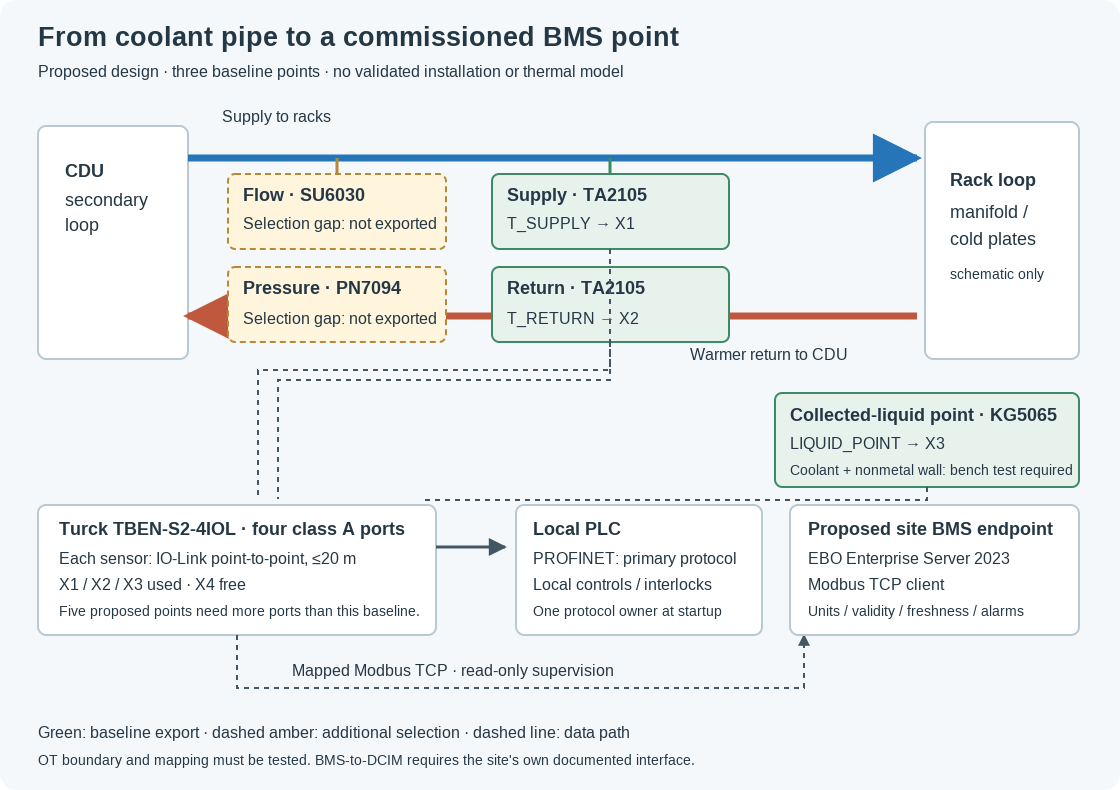
A liquid-cooling loop needs identifiable supply and return temperatures and a place to check for collected liquid. This example prepares those three points. Flow and pressure remain separate selection work. ifm cooling-monitoring overview; environmental-monitoring overview.
Model
The exact baseline has one Turck TBEN-S2-4IOL four-port master: two ifm TA2105 sensors on X1 supply and X2 return, a proposed KG5065 liquid-detection point on X3, and X4 free. SU6030 flow and PN7094 pressure candidates are outside the model and export. Five sensors need more than four ports; a completed design needs a second master or an eight-port master.
Open the three-point baseline in Studio
Settings
Temperature
The TA2105 measures −50 to 150 °C, uses IO-Link COM2 and has DeviceID 377. Its process connection is G¼; the product table distinguishes 25 mm installation length from 12 mm probe length. Confirm adapter, wetted materials, immersion and response in the actual pipe. ifm TA2105 product data.
Our two exported devices both use 0–60 °C analogue scaling. These ASP2/AEP2 values define an analogue span; they are not IO-Link alarm thresholds or approved coolant operating limits. The existing catalog IODD mapping gives ASP2 at index 630, raw 0, and AEP2 at index 631, raw 600 (0.1 °C per raw count). The digital temperature value remains its own process-data measurement.
A supply/return difference does not establish cooling capacity; that also needs measured flow, actual coolant properties and validated sensor placement.
Flow selection
The ultrasonic SU6030 covers 0.5–65 L/min with a G½, DN15 connection and a −20 to 100 °C media range. Its specified accuracy for 35% glycol is ±(5.0% of measured value + 0.5% of final range value); water has a different specification. For additives above 10%, only repeatability is stated except for explicitly characterized media. Identify the actual coolant mix before applying those figures. Wetted parts include 316L and an NBR reinforced-fiber connection seal, so material compatibility also needs checking. SU6030 manufacturer datasheet.
Plan the specified 5 DN upstream and 1 DN downstream straight lengths and follow the installation guidance. A DN15 instrument must fit the chosen branch, rather than being assumed to suit the CDU's whole loop. SU6030 is outside this baseline's catalog and commissioning file; no device registers or settings are invented here. ifm SU installation and setup.
Pressure selection
The PN7094 offers a −1 to 10 bar measurement range. It is a candidate to evaluate against the site's operating and transient pressures; this does not specify a safe CDU pressure. It measures process pressure, not air differential pressure across filters. The existing catalog's PN7092 is a different 0–100 bar device and is not substituted into this export. PN7094 installation, materials and IODD mapping remain work for the completed design. PN7094 manufacturer datasheet.
Liquid detection
KG5065 is a non-flush capacitive sensor with a nominal 12 mm sensing range and IO-Link DeviceID 387. ifm describes KI/KG family use for liquid point-level sensing through nonmetal walls. That supports a principle to investigate; it does not qualify this exact sensor, coolant and tray. KG5065 manufacturer datasheet; ifm sensor catalog, KI/KG point-level family.
The proposed dry-side location faces a nonmetal collection wall. Bench-test the actual coolant, wall thickness, stand-off and dry/wet teach, then challenge deposits and condensation. Liquid has to reach that collection point: this is not a calibrated leak detector, a leak-location rope or coverage of every possible leak path.
Blocked setting. The displayed 5% hysteresis is an illustrative Studio value, not a qualified teach result or factory setting. The catalog has no verified ISDU scale converting that percentage to a raw write. The export keeps the raw value null with its warning. Resolve the ISDU mapping before any hardware write.
Control
IO-Link connects each sensor point-to-point to a master port, up to 20 m away. The master has a separate Ethernet uplink. IO-Link Community FAQ.
The TBEN-S2-4IOL has four class A ports. A local PLC can own PROFINET and local controls/interlocks. Turck documents protocol selection at startup and read-only access through other supported protocols after selection; establish one writing owner. Turck product data; Turck April 2025 manual, pp. 12 and 59–64.
EcoStruxure Building Operation Enterprise Server 2023 documents a Modbus TCP client/server. A proposed BMS client could read Turck process inputs after site commissioning. Verify register addresses, byte order, signed scaling, validity, freshness and watchdog recovery across the site's controlled OT boundary. Schneider Enterprise Server documentation.
This Turck/EBO mapping uses documented capabilities but has not been tested as a combined product. It supplies no native BACnet or arbitrary DCIM integration claim. The site must approve alarms and any onward BMS/DCIM interface; supervisory polling does not replace local PLC control.
Commissioning
- Mark supply/return, identify the actual coolant and operating envelope, and qualify adapters, wetted materials, immersion and response. Finish flow/pressure selection and port capacity.
- Bench-test the KG5065 with the actual coolant, nonmetal wall, stand-off and dry/wet teach. Challenge deposits and condensation; record collection paths it misses. Resolve the blocked ISDU scale.
- Confirm identities, IODDs, cycle times, power, cables and data storage. Approve only verified settings and retain readback; leave unresolved writes blocked.
- Check PLC/BMS mapping against known inputs, unplug a sensor, interrupt the network and restart the master. Prove invalid/stale indications and watchdog recovery while local controls remain independent.
- Agree alarm response and acceptance with site operations. Record installation, commissioning and physical acceptance separately; monitoring alone proves no cooling-capacity, uptime, Tier-compliance or leak-free claim.
Downloads
The station JSON matches the model link exactly. The existing exporter prepares commissioning files and the report; nothing is written to a sensor. Review all settings and retain the KG5065 blocker.
Download the preparation files: station JSON · commissioning JSON · commissioning CSV · printable report · scope and blockers.
With iolinki, AI-assisted engineering can turn a coolant-loop brief into a candidate sensor selection, named master ports and commissioning files. For this example, prepare two TA2105 temperature points and a KG5065 collection-point candidate on the TBEN-S2-4IOL, then inspect X1–X3 and the exported parameter rows. That prepares a design review; an engineer still qualifies the coolant, resolves blocked settings and commissions the hardware.