Blog · Application example
IO-Link on a data-center liquid-cooling loop
Two temperatures, flow, pressure and a collected-liquid point: a concrete route from sensor selection to commissioning.
Follow the coolant first
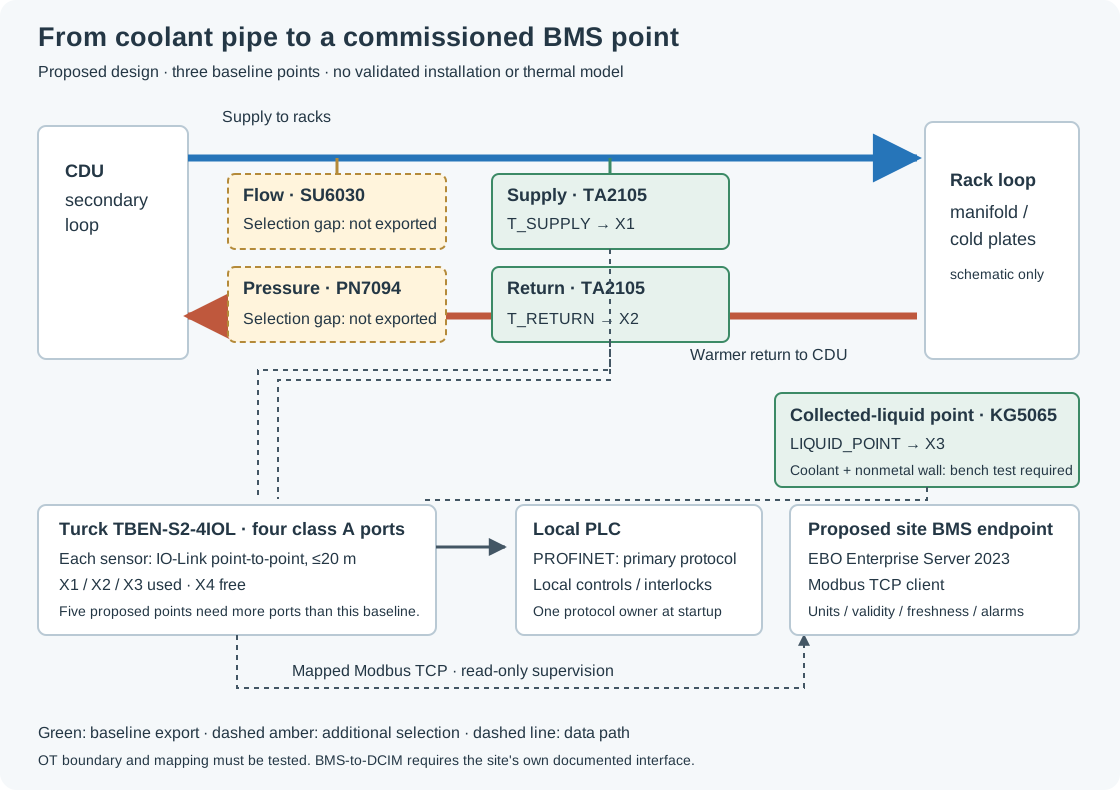
The coolant distribution unit (CDU) sends secondary-loop coolant to rack manifolds and cold plates, then receives a warmer return. The commissioning questions are concrete: which pipe is supply, which is return, does coolant move through the intended branch, and does liquid collect where someone can detect it?
IO-Link can carry device values and diagnostics back to a nearby master, giving the commissioning engineer a defined point to check. ifm describes temperature, flow and pressure monitoring for data-center cooling, alongside environmental monitoring. The arrangement below is our proposed example, not a vendor-approved combined system or a deployed installation. ifm cooling-monitoring overview; environmental-monitoring overview.
Choose five measurement points, export three
A useful first design asks for supply temperature, return temperature, branch flow, loop pressure and a local collected-liquid indication. Each IO-Link device uses its own master port. The baseline below has four ports and three proposed sensors; all five points would exceed its capacity. Select a second master or an eight-port master when completing the design, and recheck power, cabling and protocol ownership.
| Point | Device | In this export | Before installation |
|---|---|---|---|
| Supply temperature | ifm TA2105 | T_SUPPLY, X1 | Wetted materials, adapter, immersion and response |
| Return temperature | ifm TA2105 | T_RETURN, X2 | Same checks; confirm physical return location |
| Collected-liquid point | ifm KG5065 candidate | LIQUID_POINT, X3; suitability unverified | Actual coolant and nonmetal wall bench test; teach and raw scale unresolved |
| Branch flow | ifm SU6030 candidate | Not in baseline catalog/export | Flow range, fluid, seal compatibility and straight pipe lengths |
| Loop pressure | ifm PN7094 candidate | Not in baseline catalog/export | Actual operating/transient pressures, wetted materials and installation |
Temperature: two TA2105 transmitters
The TA2105 measures −50 to 150 °C, uses IO-Link COM2 and has DeviceID 377. Its process connection is G¼; the product table distinguishes 25 mm installation length from 12 mm probe length. Confirm adapter, wetted materials, immersion and response in the actual pipe. ifm TA2105 product data.
Our two exported devices both use 0–60 °C analogue scaling. These ASP2/AEP2 values define an analogue span; they are not IO-Link alarm thresholds or approved coolant operating limits. The existing catalog IODD mapping gives ASP2 at index 630, raw 0, and AEP2 at index 631, raw 600 (0.1 °C per raw count). Both settings are within their filed ranges and neither is clamped. The digital temperature value remains its own process-data measurement.
A supply/return difference can help investigate a loop, but it does not establish cooling capacity. A heat-transfer estimate also needs measured flow, actual coolant properties and validated sensor placement; this partial example supplies none of that evidence.
Flow: SU6030 is a selection candidate
The ultrasonic SU6030 covers 0.5–65 L/min with a G½, DN15 connection and a −20 to 100 °C media range. Its specified accuracy for 35% glycol is ±(5.0% of measured value + 0.5% of final range value); water has a different specification. For additives above 10%, only repeatability is stated except for explicitly characterized media. Identify the actual coolant mix before applying those figures. Wetted parts include 316L and an NBR reinforced-fiber connection seal, so material compatibility also needs checking. SU6030 manufacturer datasheet.
Plan the specified 5 DN upstream and 1 DN downstream straight lengths and follow the installation guidance. A DN15 instrument must fit the chosen branch, rather than being assumed to suit the CDU's whole loop. SU6030 is outside this baseline's catalog and commissioning file; no device registers or settings are invented here. ifm SU installation and setup.
Pressure: choose a range for the real loop
The PN7094 offers a −1 to 10 bar measurement range. It is a candidate to evaluate against the site's operating and transient pressures; this does not specify a safe CDU pressure. It measures process pressure, not air differential pressure across filters. The existing catalog's PN7092 is a different 0–100 bar device and is not substituted into this export. PN7094 installation, materials and IODD mapping remain work for the completed design. PN7094 manufacturer datasheet.
Collected liquid: a local point needs a physical test
KG5065 is a non-flush capacitive sensor with a nominal 12 mm sensing range and IO-Link DeviceID 387. ifm describes KI/KG family use for liquid point-level sensing through nonmetal walls. That supports a principle to investigate; it does not qualify this exact sensor, coolant and tray. KG5065 manufacturer datasheet; ifm sensor catalog, KI/KG point-level family.
The proposed dry-side location faces a nonmetal collection wall. Bench-test the actual coolant, wall thickness, stand-off and dry/wet teach, then challenge deposits and condensation. Liquid has to reach that collection point: this is not a calibrated leak detector, a leak-location rope or coverage of every possible leak path.
Keep the raw-write warning. The displayed 5% hysteresis is an illustrative Studio value, not a qualified teach result or factory setting. The catalog has no verified ISDU scale converting that percentage to a raw write. The export therefore keeps the hysteresis raw value empty with its warning; do not turn the percentage into a guessed register value.
From IO-Link ports to a real supervisory endpoint
IO-Link is a local point-to-point connection from a device to a master port, with a maximum 20 m sensor link. The sensor is not directly on Ethernet. The master carries the values onto its separate network uplink. IO-Link Community FAQ.
The proposed baseline uses Turck's TBEN-S2-4IOL, a four-port class A master. A local PLC can own the primary PROFINET connection and local controls/interlocks. The master selects a supported protocol at startup; after selection, other supported protocols are available read-only. This is one protocol owner, not two independent writing controllers. Turck product data; Turck April 2025 manual, pp. 12 and 59–64.
For a concrete proposed supervisory endpoint, EcoStruxure Building Operation Enterprise Server 2023 supports a native Modbus TCP client/server. Its client could read the Turck's mapped process inputs for the BMS, subject to site commissioning. Verify register addressing, byte order, signed temperature scaling, device validity, freshness and watchdog behavior. Label stale data invalid instead of holding a believable last value. Network access must cross the site's controlled OT boundary. Schneider Enterprise Server 2023 documentation.
This proposes an integration using documented capabilities; it is not a tested Turck/EBO combined product. Alarm limits, delays, escalation and recovery belong to the site's reviewed operating design. Any BMS-to-DCIM connection needs that site's documented, tested interface. The master is not claimed to provide native BACnet or arbitrary DCIM compatibility, and the supervisory link does not replace local control.
Open the exact partial baseline
The Studio example contains one TBEN-S2-4IOL, two TA2105 sensors and one proposed KG5065 point: X1 supply, X2 return, X3 collected liquid, X4 free. Two generic pipe runs and a cabinet help identify positions. They are not a modeled CDU, server rack, tray geometry or a hydraulic/thermal simulation.
Open the three-point baseline in Studio
Inspect the wiring, port table and settings. If you press Run, the existing Studio curves are illustrative signals, not measured coolant data. The downloadable JSON is the exact station serialized in the link; the commissioning files and report are generated from it using the existing exporter. These files prepare engineering work. Nothing is written to a sensor.
Download the preparation files: station JSON · commissioning JSON · commissioning CSV · printable report · scope and blockers.
With iolinki, AI-assisted engineering can turn a coolant-loop brief into a candidate sensor selection, named master ports and commissioning files. For this example, prepare two TA2105 temperature points and a KG5065 collection-point candidate on the TBEN-S2-4IOL, then inspect X1–X3 and the exported parameter rows. That prepares a design review; an engineer still qualifies the coolant, resolves blocked settings and commissions the hardware.
Commissioning: turn the proposal into evidence
- Confirm the loop and the job. Mark supply/return, identify the coolant and branch operating envelope, and define each measurement location. Review adapters, pressure ratings, materials, immersion and flow installation lengths.
- Finish the instrumentation. Qualify flow and pressure candidates, add sufficient ports, and review sensor current, cable routes, pinout and the 20 m link limit. Include connectors and mounting hardware in the installation bill.
- Bench-test the collected-liquid point. Record actual wall/coolant geometry, dry/wet teach, condensation/deposit trials and the collection paths it misses. Resolve hysteresis mapping before any proposed raw write.
- Read devices before writing. Confirm vendor/device IDs, serials, IODDs and minimum cycle times. Review data-storage support. Write only verified settings after qualification, then retain readback; leave unresolved values blocked.
- Test the supervisory mapping. Establish the master protocol owner, confirm PLC/BMS points against known inputs, unplug a sensor, interrupt the network and restart the master. Prove invalid/stale indications and watchdog recovery. Keep local controls and interlocks independent of BMS polling.
- Agree acceptance with site operations. Set approved alarms and response actions, test them under the site's procedure, and record installation, commissioning and physical acceptance separately. Monitoring alone establishes no cooling-capacity, uptime, Tier-compliance or leak-free claim.