Blog · Standards & Interoperability
Multi-vendor IO-Link compatibility and IODD parameter mapping
A practical guide to connecting sensors from any manufacturer to masters from Turck, Siemens, and ifm without proprietary lock-in.

The multi-vendor promise vs reality
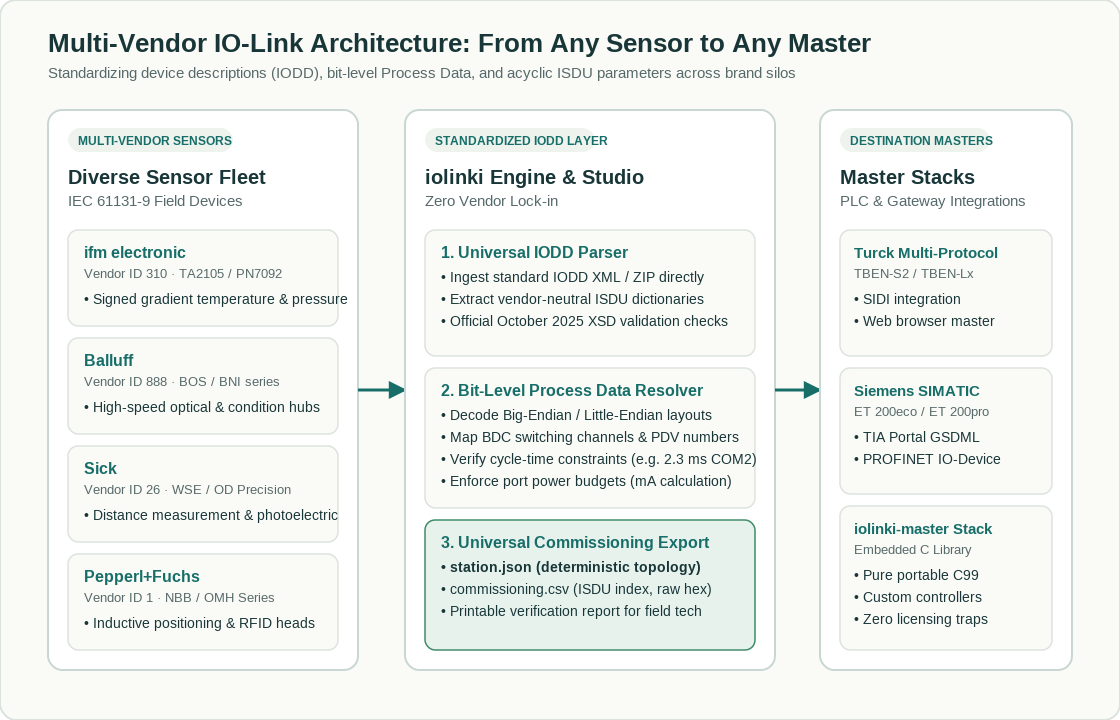
The IO-Link specification (IEC 61131-9) was established to create a universally standardized, fieldbus-independent interface for smart sensors and actuators. In theory, an IO-Link device from any manufacturer (such as ifm electronic, Balluff, Sick, or Pepperl+Fuchs) can plug directly into an IO-Link master from another vendor (such as Turck, Siemens, or Festo) using standard 3-wire unshielded M12 cables.
In practice, automation engineers frequently run into friction when mixing brands. The hurdles rarely stem from the physical PHY layer; rather, they arise from device description (IODD) interpretation, endianness mismatches in cyclic process data, and proprietary master configuration software.
Three common cross-vendor integration pitfalls
1. Endianness and bit-offset alignment in Process Data
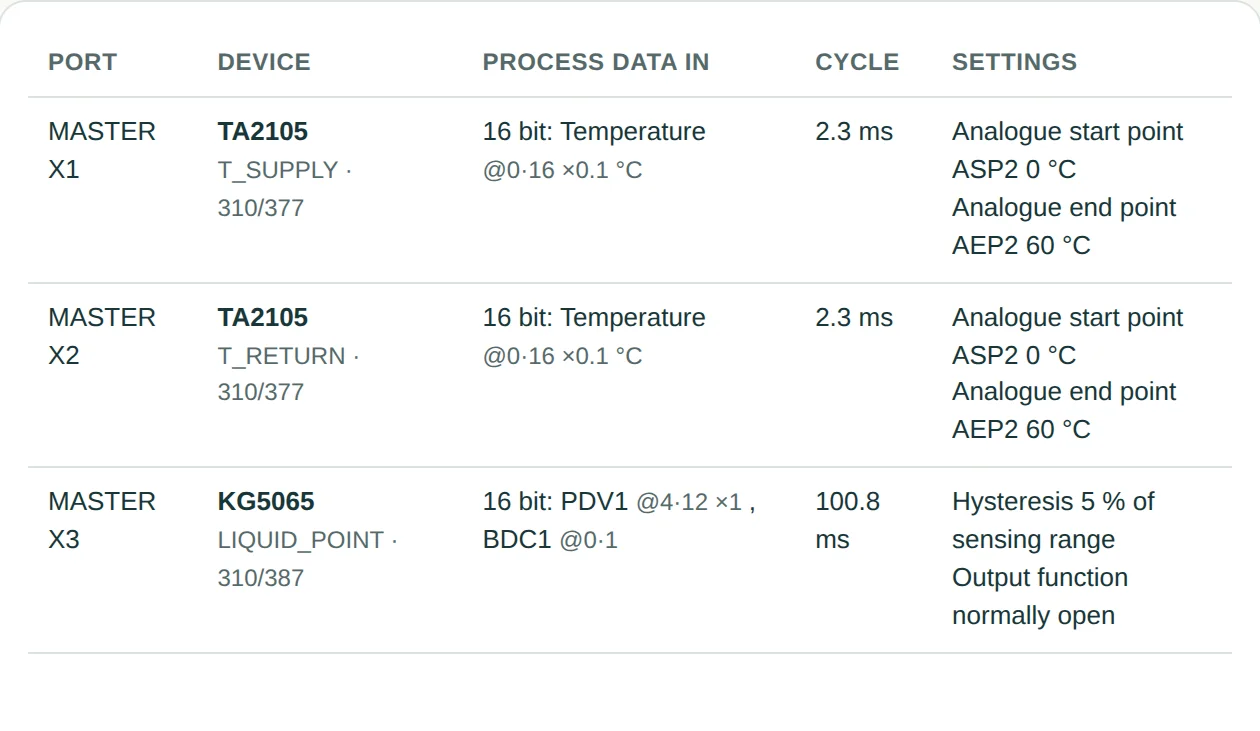
IO-Link transfers cyclic process data over the communication channel in big-endian network byte order. However, how individual vendors structure their bit fields can vary dramatically:
- Binary Data Channels (BDC): Switching signals (such as
OUT1andOUT2) often occupy bits 0 and 1 of byte 0, but some sensors place them at the high byte of a 16-bit or 32-bit word. - Measurement Values (PDV): Analog readings (temperature, pressure, distance) may be 12-bit, 14-bit, or 16-bit integers, requiring bit-shift operations in the PLC to separate measurements from switching flags.
- Gradient and Scaling: Raw integer counts must be multiplied by specified gradients (e.g., 0.1 bar or 0.01 °C) to yield physical engineering units.
2. Acyclic ISDU index differences
While the IO-Link standard standardizes direct parameter page 1 and identification indices (Index 0x0010 for Vendor Name, 0x0012 for Product Name), device-specific operational settings (such as switch point SP1, reset point rP1, and hysteresis) are defined at vendor-chosen ISDU indices. For example:
- An ifm PN7092 pressure transmitter maps Set Point SP1 to Index 583 (0x0247), Subindex 0, as a 16-bit IntegerT scaled at 0.1 bar.
- A comparable sensor from another manufacturer might map SP1 to Index 64 or Index 1000, with different raw scaling or unsigned datatypes.
Automating device replacement requires extracting these exact index definitions from the device's official IODD XML rather than guessing parameter addresses.
3. Cycle time and port power budgets
Different sensors operate at different standard baud rates: COM1 (4.8 kBaud), COM2 (38.4 kBaud), or COM3 (230.4 kBaud). A high-speed optical distance sensor (e.g., ifm O5D100) running at COM2 may require a minimum cycle time of 2.3 ms, whereas complex multi-channel condition monitoring hubs might demand 10 ms or more.
Additionally, electrical power budgets must be validated. Industrial multiport masters typically deliver between 500 mA and 2000 mA per port, but have an aggregate current cap (e.g., 4000 mA across all ports). Summing sensor quiescent current and peak switching loads ensures reliable operation without mysterious brownouts.
Standardizing cross-vendor workflows with iolinki
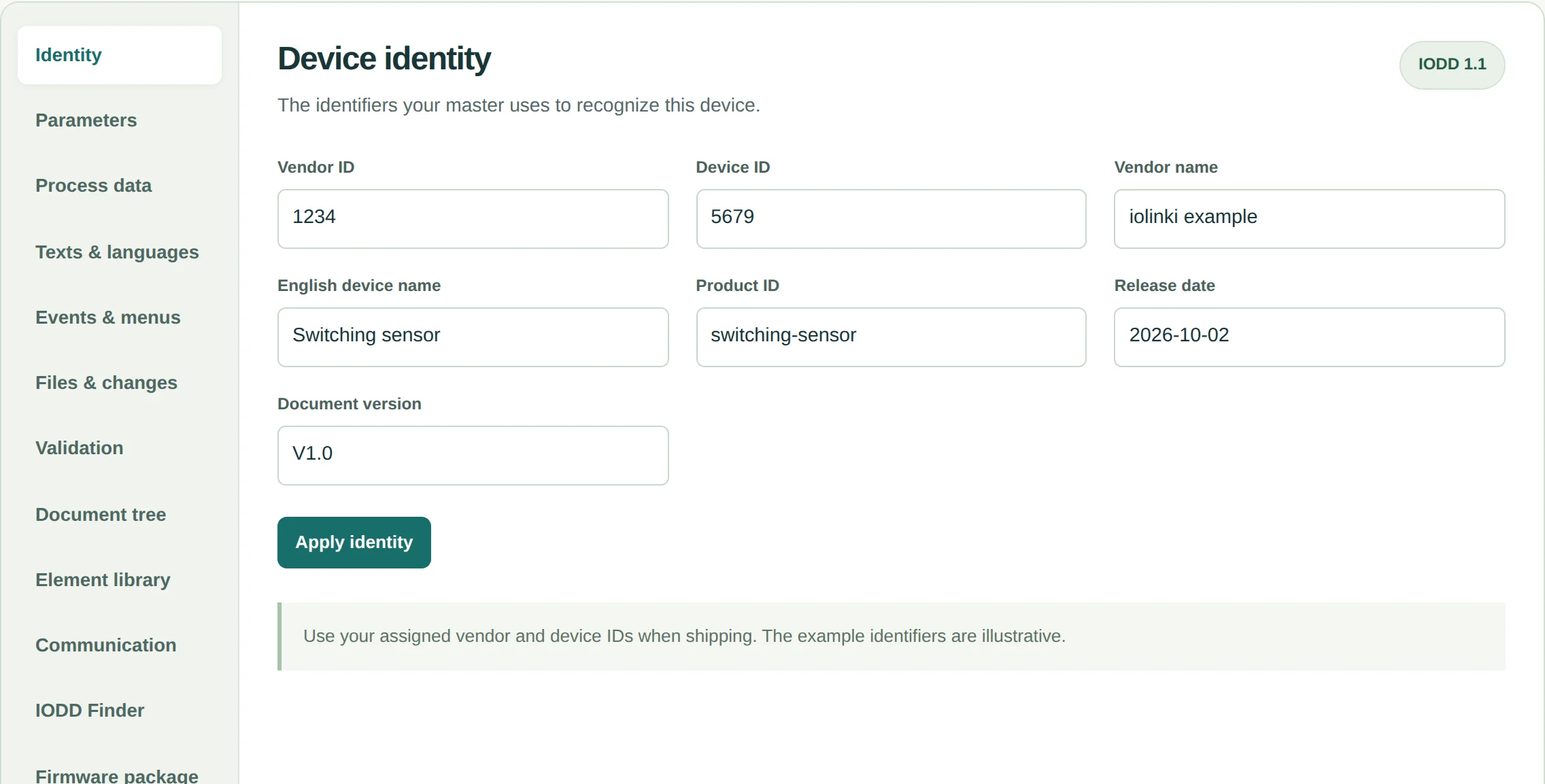
The iolinki Station Studio and IODD editor resolve multi-vendor integration friction through standard-compliant automation:
- Automated IODD Ingestion: Drag and drop any vendor's IODD package to immediately inspect the parameter map and process data layout.
- Cross-Vendor Station Simulation: Mix masters and sensors from different manufacturers on the same 3D station. The studio verifies cycle-time compatibility and total power draw in real time.
- Universal Commissioning Deliverables: Export a deterministic
station.jsonfile andcommissioning.csvcontaining explicit port numbers, vendor IDs, device IDs, cycle times, and raw ISDU parameters ready for download by any PLC programmer.
Next steps
Build confidence in your multi-vendor architecture before commissioning on the plant floor:
- Design and simulate a mixed-vendor cell in the Station Studio.
- Inspect and validate your device descriptions in the online IODD editor.
- Review the validation evidence for our open-source, portable IO-Link protocol stacks.